Share Incentive Plan Calculator: UK SIP, RSU & ESPP Tax
A Share Incentive Plan (SIP) is a UK tax-advantaged employee share scheme. Shares held in the plan for five years leave it free of Income Tax and National Insurance under HMRC rules. This calculator shows your after-tax value for a SIP, and for RSUs, ESPP shares and stock options if your equity sits outside the UK.
Share Incentive Plan Calculator
Your plan details
Fill in your plan details and press Calculate my equity value — you'll get after-tax value, the tax breakdown bar, a growth chart and a year-by-year table.
Year-by-year projection
Estimates for planning only — not financial, tax or investment advice. UK SIP figures follow HMRC rules for free (£3,600/yr), partnership (£1,800/yr or 10% of salary) and matching shares (max 2:1), with Income Tax and NIC relief and the under-3 / 3–5 / 5+ year withdrawal treatment. US figures follow IRS supplemental withholding (22%), FICA and Section 423 ESPP treatment. Confirm your position with a qualified adviser.
How to read your results
The calculator gives you five numbers. Here is what each one means before you act on it.
- Plan value is a projection, not a promise. It compounds your share price at the growth rate you entered. Run it again at 0% growth to see your floor.
- True net cost matters most for partnership shares. You buy them from gross pay, so Income Tax and National Insurance relief lands before the money reaches your payslip. A higher-rate taxpayer who puts in £1,800 gives up roughly £1,044 of take-home pay — and that holds whether the share price rises or falls.
- Withholding gap appears in the RSU and options modes. Vesting RSUs are withheld at a flat 22% supplemental rate; if your actual marginal rate is 32% or 35%, the shortfall turns up as a balance due when you file. Treat the amber figure as money you owe, not money you have.
- Sell-to-cover tells you how many shares the plan sells to fund that withholding, and how many you keep. Two hundred shares vesting rarely means two hundred shares arriving.
- Break-even applies to options. Below the strike price, options are worth nothing at all, regardless of how many you hold.
- The three withdrawal cards show the same holding taxed under three timings: under three years, three to five years, and five years or more. The difference between the first and last card is usually the largest number on the page.
Judging your result is simple: compare the five-year card against the cash bonus you would have taken instead. That comparison, not the headline projection, is the decision you are actually making.
What a Share Incentive Plan actually is
A SIP lets you acquire shares in your employer, either given to you or bought from your pre-tax salary, with Income Tax and NIC relief tied to how long you keep them. It arrived in the Finance Act 2000 and is one of four tax-advantaged share plans in the UK, alongside Save As You Earn (SAYE), Enterprise Management Incentives (EMI) and the Company Share Option Plan (CSOP).
One detail almost every calculator site gets wrong: a SIP is no longer an “HMRC-approved” plan. Approval was required before 6 April 2014. Since then the employer self-certifies that the plan meets the legislation. The rules sit in Schedule 2 of the Income Tax (Earnings and Pensions) Act 2003, and the plan is registered and reported through HMRC’s ERS Online service via the company’s Government Gateway account.
A SIP is an all-employee plan. Every qualifying employee and director must be eligible, must be invited, and must participate on the same terms — your employer cannot offer it to managers only. A qualifying service period of up to 18 months can be set, and how awards are allocated between employees follows its own statutory rules.
Your shares do not sit in your brokerage account. A UK employee trust holds them on your behalf, administered by independent trustees who keep the records and handle HMRC compliance. You own them; the trust holds them until they leave the plan.
The shares must be ordinary shares, fully paid and not redeemable, though they can carry no votes. Where the company is not listed, the market value used for an award can be agreed with HMRC’s Shares and Assets Valuation office in advance. Everything runs on the UK tax year, 6 April to 5 April, and annual limits reset on 6 April.
Source: HMRC’s guide for employees (IR177) and HMRC’s ETASSUM share scheme manual.
The four types of SIP shares
| Share type | Annual limit | Who pays | Tax-free after |
|---|---|---|---|
| Free shares | £3,600 | Your employer | 5 years |
| Partnership shares | £1,800, or 10% of salary if lower | You, from gross pay | 5 years |
| Matching shares | Up to 2 for every partnership share | Your employer | 5 years |
| Dividend shares | No statutory limit | Your own dividends, reinvested | 3 years |
If your employer runs free, partnership and matching shares at full strength, the combined maximum in one tax year is £9,000.
Two points are commonly reported incorrectly. Dividend shares have no statutory cap — a £1,500 annual reinvestment limit existed once, but the Finance Act 2013 removed it for 2013-14 onwards, so any limit today is your employer’s own. And dividend shares run on three years, not five, with no National Insurance charged on them at all.
Partnership shares have a monthly shape most write-ups skip: a maximum of £150 a month or 10% of salary, whichever is lower, with a £10 monthly minimum. Your employer may run an accumulation period of up to 12 months, with shares bought within 30 days of the period ending.
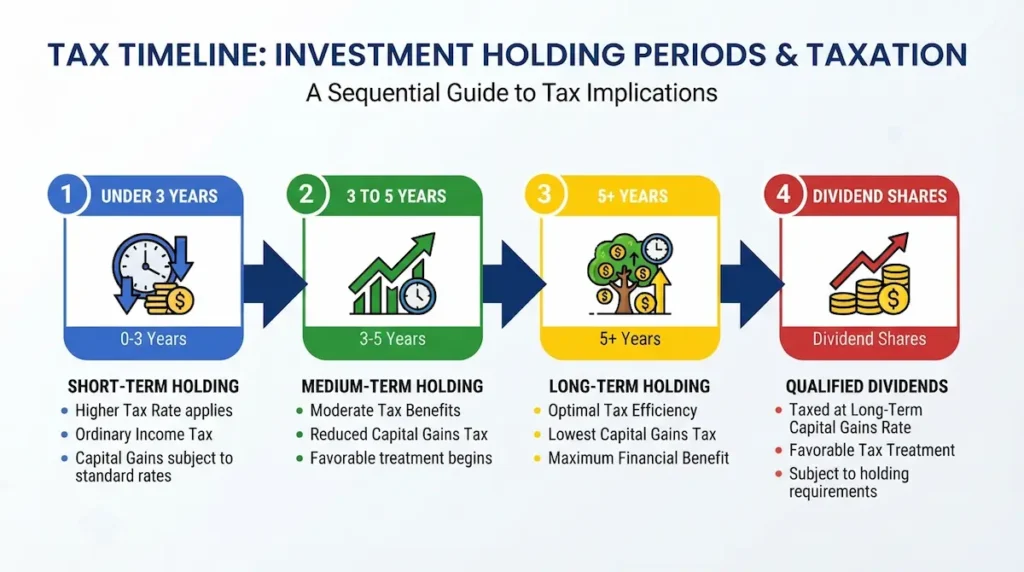
The 5-year rule, and what really happens at three years
Three timings decide your tax. The figures below assume you are not a good leaver, which is a separate case.
- Under three years. Income Tax and National Insurance are charged on the full market value of the shares on the day they leave the plan, growth included. Take out £3,000 of free shares at year two as a higher-rate taxpayer and roughly £1,260 goes in Income Tax and NIC.
- Three to five years. This is where accuracy matters, because several calculator sites describe it as “Income Tax on the original value, Capital Gains Tax on the growth.” That is not the rule. Income Tax and NIC are charged on the lower of the value when the shares were awarded and their market value on the day they are withdrawn. Growth inside the plan is free of Income Tax — and if the price has fallen, the lower figure is the current value, so the fall works in your favour.
- Five years or more. No Income Tax and no NIC when the shares come out. This is the whole point of the scheme.
- Dividend shares clear at three years. Withdraw them earlier and Income Tax is due on the cash dividend that bought them, at the dividend rate applying when you withdraw.
Where Capital Gains Tax actually sits
While the shares are held in the SIP trust, any increase in value is free from CGT. Taking them out is not a disposal either. CGT only becomes relevant if you hold the shares after withdrawal and sell later at a higher price — and then only on the gain from the withdrawal date, against your annual exempt amount (£3,000 for 2026/27).
The 90-day ISA route
You can transfer SIP shares into a Stocks and Shares ISA within 90 days of them leaving the plan, up to £20,000 in a tax year. The transfer itself is not chargeable to CGT, and growth inside the ISA is not either. Miss the 90-day window and the route closes.
What partnership shares actually cost you
Partnership share money is deducted before tax and NIC. Using 2026/27 rates for England, Wales and Northern Ireland:
| Your band | Relief rate | You contribute | Relief | True cost to you |
|---|---|---|---|---|
| Basic rate | 20% + 8% NI = 28% | £1,800 | £504 | £1,296 |
| Higher rate | 40% + 2% NI = 42% | £1,800 | £756 | £1,044 |
| Additional rate | 45% + 2% NI = 47% | £1,800 | £846 | £954 |
Employee National Insurance is 8% between £12,570 and £50,270 and 2% above that, which is why higher and additional rate taxpayers see a smaller NI saving but a larger Income Tax one.
Now add a match. At 1:1, that £1,044 of take-home pay becomes £3,600 of shares — about 3.4 times the cash you gave up, before the share price moves. At the 2:1 maximum it is £5,400. Three caveats: matching is at your employer’s discretion and many plans offer less than 1:1 or nothing; the five-year clock still has to run; and the shares can fall in value, which no relief protects you from. Scottish taxpayers use different Income Tax bands (19%, 20%, 21%, 42%, 45% and 48%), so your relief rate will differ.
What happens to your SIP shares when you leave
Once your employment ends, your shares must come out of the plan. That part is not a choice. The shares still belong to you, but they leave the trust, and what you are left with depends on why you left and how long each tranche had been held.
- Good leaver reasons protect you completely. Injury, disability, redundancy, retirement, death, or a transfer of the business under TUPE mean no Income Tax or NIC on your plan shares regardless of holding period. Someone made redundant in year two keeps the same tax outcome as someone who stayed the full five years.
- Resignation and dismissal do not. The normal withdrawal rules apply: full market value taxed under three years, the lower of award value and withdrawal value between three and five.
- Dividend shares sit on their own track — a good leaver avoids Income Tax on them even inside the three-year window, while a non-qualifying leaver is taxed on the dividends used to buy them in the preceding three years. Matching shares can be forfeited if you take out the partnership shares they were attached to, or leave early; what gets forfeited and what gets taxed are two separate risks worth pricing before you resign.
The practical step: check the award date of each tranche before accepting an offer. On £15,000 approaching the five-year mark, leaving two months early costs around £6,300 at higher rate; waiting costs nothing. Your plan document, not this page, defines your employer’s leaver categories.
The RSU tax gap nobody warns you about
When RSUs vest, the fair market value becomes ordinary income on that date. It goes on your W-2 whether you sell or hold, with no election to defer it and no capital gains treatment at that point. A $100,000 grant vesting over four years is therefore not $100,000 of cash — compare offers on after-tax value, not headline grant size.
RSU vesting is treated as supplemental wages, withheld at a flat 22% federal rate (37% on the excess once supplemental wages pass $1 million in a calendar year). Flat 22% is fine if your bracket is 22%. At 32%, 35% or 37%, your employer has under-withheld, and the shortfall becomes a balance due when you file.
A worked figure. $250,000 of RSUs vest, 32% federal bracket:
| Item | Amount |
|---|---|
| Ordinary income at vest | $250,000 |
| Withheld at 22% | $55,000 |
| Actually owed at 32% | $80,000 |
| Shortfall due at filing | $25,000 |
That $25,000 is not a penalty. It is tax you always owed, collected later. Two ways to close it: a revised Form W-4 adding withholding across your remaining pay periods, or quarterly estimated tax payments. Doing neither can add an underpayment penalty, and the safe harbour thresholds that switch that penalty off are worth knowing before your next vest.
State tax stacks on separately. California adds up to 13.3%, turning a 32% federal rate into a combined rate above 41% before FICA. New York City residents face state and city tax together. Texas, Florida, Washington and Nevada charge nothing on the same vest.
Sources: IRS Publication 15 for supplemental withholding, IRS Publication 525 for taxable compensation.
FICA, sell-to-cover, and the shares you actually keep
For 2026, Social Security is 6.2% on wages up to $184,500 (a maximum of $11,439), Medicare is 1.45% with no cap, and an Additional Medicare Tax of 0.9% applies once wages pass $200,000. If your salary alone has already cleared $184,500 before the vest, Social Security stops and your effective FICA on those shares drops from 7.65% to 1.45% — a January vest and a November vest can net differently for that reason alone. The 3.8% Net Investment Income Tax does not apply at vesting; it can apply to gains after you sell, above $200,000 single or $250,000 joint.
Sell-to-cover is where the share count changes. Most plans sell enough vesting shares to fund the withholding; some use net settlement instead, cancelling shares and paying the tax from company cash.
| Shares vesting | 200 |
|---|---|
| Income at $108 | $21,600 |
| Withheld (22% + FICA) | $6,404 |
| Shares sold to cover | 59 |
| Shares delivered to you | 141 |
Keep your own record of the vesting price. Broker cost basis on Form 1099-B is frequently understated on equity compensation, and your vest-date value is your basis. Save the statement.
ESPP: should you sell straight away or hold?
A Section 423 plan lets you buy company stock at a discount of up to 15% through payroll deductions over an offering period, often six months. You are limited to $25,000 of stock a year, measured by the share price on the offering date, not what you pay — $50 at offering means 500 shares a year, costing $21,250 at a 15% discount.
The lookback is the part worth understanding. With a lookback, the discount applies to the lower of the offering-date and purchase-date prices: offering $100, purchase $200, your cost $85 for stock worth $200. Plans without one simply discount the purchase-date price. Check which you have — it changes the return far more than the discount percentage does.
Sell at purchase (disqualifying disposition): the spread is ordinary income, with no market risk. Section 423 shares are not subject to FICA even here, which makes this cheaper than equivalent RSU income. Hold for a qualifying disposition (two years from offering, one from purchase): ordinary income is capped at the offering-date discount and the rest is long-term capital gain — though that ordinary income is not withheld, so estimated payments may be needed.
$5,000 per period, 15% discount, $50 at offering and $55 at purchase, with a lookback — 117 shares at $42.50, worth $6,470. At 32% ordinary and 15% long-term:
| Sell at purchase | Hold to qualifying | |
|---|---|---|
| Gross gain | $1,471 | $2,547 (at 8% growth) |
| Taxed as ordinary income | $1,471 | $882 |
| Taxed at long-term rate | — | $1,665 |
| After-tax profit | $1,000 | $2,015 |
Holding wins on paper. It also means two more years in a single stock, and a 20% fall erases the advantage. If your employer’s stock already dominates your net worth through RSUs, taking the certain profit and diversifying is the stronger decision even though it costs more tax — your salary is already tied to this company, and a share price fall and a redundancy round tend to arrive together. ESPPs do not trigger AMT, which is one thing they get right that ISOs do not.
Stock options: ISO, NSO, and your break-even price
An option is a right to buy shares at a fixed price. It is not a share.
Your break-even is the strike price. 1,000 options with a $50 strike, while the stock trades at $48, are worth nothing. Value exists only in the spread above the strike, so 10,000 options at a $50 strike deliver less than 1,000 shares of stock if the price never clears $50. Always ask for the strike price and the current valuation before weighing an offer that leans on options.
NSOs are taxed at exercise — the spread is ordinary income, withheld through payroll like a bonus.
ISOs defer that, and hand you a different problem. No ordinary Income Tax at exercise; hold one year from exercise and two from grant and the whole gain is long-term capital gain. But the spread at exercise is an AMT preference item on Form 6251, so you can owe tax on a paper gain in shares you cannot sell. For 2026 the AMT exemption is $90,100 single and $140,200 joint, at rates of 26% and 28%, and the 2025 legislation tightened the phaseout: the exemption falls by 50 cents per dollar of AMT income above $500,000 single or $1 million joint.
Two limits catch people out. Only $100,000 of ISO stock, measured at grant, can first become exercisable in a calendar year under Section 422(d) — anything above the line becomes an NSO automatically. And after you leave, you generally have 90 days to exercise and keep ISO status; miss the window and unexercised options expire worthless. If your company is private, treat the 409A valuation as a compliance figure for the strike price, not a forecast of an exit.
Source: IRS Topic No. 427.
SIP compared with the UK’s other share schemes
| Scheme | Who it is for | Individual limit | When tax bites |
|---|---|---|---|
| SIP | All employees | £3,600 free + £1,800 partnership a year | On withdrawal. Nothing after 5 years |
| SAYE | All employees | £500 a month saved | At option exercise |
| EMI | Selected staff, qualifying smaller companies | £250,000 at grant | On sale. BADR may apply |
| CSOP | Selected staff | £60,000 unexercised | On sale |
Two updates most pages have not caught. Business Asset Disposal Relief, often quoted at 10% for EMI shares, is 18% from 6 April 2026, up from 14% the year before, on a £1 million lifetime limit. And from April 2026 EMI eligibility widened: up to 500 full-time equivalent employees, gross assets up to £120 million, £6 million of unexercised options per company, and a 15-year maximum option life.
The structural difference matters more than the limits: a SIP hands you real shares, often with an employer match, while SAYE, EMI and CSOP give you options whose value depends on beating a fixed price. Which scheme protects your cash and which allows a discount is a separate comparison worth making if you hold more than one.
SIP or a Stocks and Shares ISA?
An ISA gives you a £20,000 annual allowance, no tax on growth or dividends, and free choice of investments. It gives you nothing for free. A SIP gives you Income Tax and NIC relief plus whatever your employer matches, which no ISA can replicate — and concentrates your savings in the company that pays your salary. You can use both: take the match, hold five years, then move the shares into an ISA within 90 days of leaving the plan and shelter future growth from CGT.
Why a UK SIP and an RSU cannot use the same maths
Several tools branded as SIP calculators run RSU logic underneath, which produces numbers wrong in both directions.
| UK SIP | US RSU | |
|---|---|---|
| When tax is charged | When shares leave the plan | On the vesting date |
| Effect of holding longer | Nil Income Tax and NIC after 5 years | No tax benefit from holding |
| Employer contribution | Free shares and up to 2:1 matching | None. The grant is the whole award |
| Your upfront cost | Partnership shares bought from gross pay | Nothing. RSUs cost you no cash |
| Withholding at acquisition | None | 22% federal supplemental, plus FICA and state |
| CGT while held | None inside the trust | Basis resets at vest, gains taxed after |
Time in a SIP removes tax. Time holding vested RSUs does nothing for the income tax already charged. That is why this calculator runs separate engines rather than one adjusted formula.
Worked examples
Every figure below comes from the calculator above, so you can reproduce them with the same inputs.
Example 1: UK basic rate, £150 a month with a 1:1 match
Share price £5, 8% annual growth, 5 years, 20% Income Tax and 8% NIC.
| Year | Shares held | Share price | Plan value |
|---|---|---|---|
| 1 | 693 | £5.40 | £3,741 |
| 2 | 1,334 | £5.83 | £7,782 |
| 3 | 1,928 | £6.30 | £12,146 |
| 4 | 2,478 | £6.80 | £16,860 |
| 5 | 2,988 | £7.35 | £21,948 |
You contributed £9,000 from gross pay; relief at 28% was £2,520, so the real cost was £6,480. Your employer matched £9,000.
| Withdraw at | Plan value | Tax and NIC | You keep |
|---|---|---|---|
| Year 2 | £7,782 | £2,179 | £5,603 |
| Year 4 | £16,860 | £4,032 | £12,828 |
| Year 5 | £21,948 | £0 | £21,948 |
Year four is taxed on £14,400 — the award value — not the £16,860 the shares are now worth. Year five is taxed on nothing.
Example 2: UK higher rate, full partnership plus free shares
£1,800 a year partnership, £1,000 a year free shares, 2:1 matching, £5 price, 8% growth, 40% Income Tax and 2% NI.
| Item | Amount |
|---|---|
| Your gross contribution over 5 years | £9,000 |
| Relief at 42% | £3,780 |
| Real cost to you | £5,220 |
| Employer’s contribution (matching + free) | £23,000 |
| Plan value at year 5 | £39,020 |
| Tax and NIC at year 5 | £0 |
A 2:1 match alongside free shares is the statutory ceiling; most employers offer considerably less. Run your own plan’s actual match.
Example 3: US RSU, 800 shares over 4 years in California
$100 share price, 8% growth, 32% federal, 9.3% California, full FICA.
| Vest | Shares | Price | Income | Withheld | Gap owed | Sold to cover | Net value |
|---|---|---|---|---|---|---|---|
| 1 | 200 | $108 | $21,600 | $8,413 | $2,160 | 78 | $11,027 |
| 2 | 200 | $117 | $23,328 | $9,086 | $2,333 | 78 | $11,909 |
| 3 | 200 | $126 | $25,194 | $9,813 | $2,519 | 78 | $12,862 |
| 4 | 200 | $136 | $27,210 | $10,598 | $2,721 | 78 | $13,891 |
| Total | 800 | $97,332 | $37,911 | $9,733 | 312 | $49,688 |
An $80,000 grant becomes $97,332 of income, $49,688 after tax, and 488 of the original 800 shares. The $9,733 gap is due at filing, not withheld.
Example 4: ESPP, $5,000 a period with a lookback
15% discount, $50 at offering, $55 at purchase, 32% ordinary, 15% long-term, 8% growth.
| Item | Amount |
|---|---|
| Purchase price with lookback | $42.50 |
| Shares bought | 117 |
| Market value at purchase | $6,470 |
| Instant paper profit | $1,471 (29.4% on your $5,000) |
| After tax if sold at purchase | $1,000 |
| After tax if held to qualifying | $2,015 |
The $1,015 difference is the price of holding a single stock for two more years.
What this calculator cannot do
AMT on ISO exercises. The calculator shows the spread and the ordinary-versus-capital gains difference, not your alternative minimum tax, which depends on total income, filing status, exemption phaseout and state AMT. A large ISO exercise is a conversation with a CPA, not a web form.
Private company valuations. A 409A valuation sets a defensible strike price; it is not a forecast, and unlisted shares may have no market to sell into.
Cross-border and multi-state positions. Living in one country while equity vests under another jurisdiction’s plan, or moving states between grant and vest, changes which tax applies and can create liability in both places. The calculator assumes one regime.
Scottish Income Tax. Scotland sets its own bands (19%, 20%, 21%, 42%, 45% and 48%) — enter your own rate.
Your pay and benefit entitlements. Partnership share money comes out of gross pay, so it reduces your earnings for other purposes. HMRC’s IR177 guidance covers the effect on contribution-based state benefits such as State Pension, on Statutory Sick Pay and Statutory Maternity Pay, on tax credits and on means-tested benefits. The effect is most serious if the deduction brings your earnings below the lower earnings limit for National Insurance (£6,708 for 2026/27). If you earn near that level, read IR177 before you enrol.
Section 83(b) elections. Restricted stock, as opposed to RSUs, allows an election to be taxed at grant instead of vest, filed within 30 days. Not modelled here.
Your plan’s own rules. Leaver definitions, accumulation periods, matching ratios, forfeiture conditions and internal caps are set by your employer within the statutory framework. Where this page and your plan document disagree, your plan document wins.
Frequently asked questions
How much can I put into a SIP each year?
Up to £1,800 of partnership shares from gross pay, or 10% of your salary if that is lower, capped at £150 a month with a £10 monthly minimum. Your employer can add £3,600 of free shares and two matching shares per partnership share, for a combined ceiling of £9,000.
What is the SIP 5-year rule?
Shares held in the SIP trust for five years leave the plan free of Income Tax and National Insurance. The five years run from the award date of each tranche, not from when you joined the plan, so awards made in different years clear at different times.
Do I pay tax if I take SIP shares out after 3 years?
Yes, but on a reduced figure. Between three and five years, Income Tax and NIC apply to the lower of the value when the shares were awarded and their market value on the day you withdraw. Growth that happened inside the plan escapes Income Tax entirely.
Do I pay Capital Gains Tax on SIP shares?
No CGT arises while shares sit in the SIP trust, and removing them is not a disposal. CGT only becomes relevant if you keep the shares after withdrawal and sell later at a higher price, on the gain from the withdrawal date, against your £3,000 annual exempt amount.
What happens to my SIP shares if I leave my job?
The shares must leave the plan, but they remain yours. Redundancy, retirement, injury, disability, death and a TUPE business transfer mean no Income Tax or NIC whatever the holding period. Resignation and dismissal are treated as normal early withdrawals and taxed accordingly.
Why do I owe more tax than my employer withheld?
RSU vesting is withheld at a flat 22% federal supplemental rate. If your marginal bracket is 32% or higher, the shortfall is not collected at vest and appears as a balance due when you file. On $250,000 of vesting shares at 32%, that gap is $25,000.
Is this calculator free and is my data stored?
It is free, with no account or email required, and nothing you enter is stored or transmitted. Every calculation runs inside your browser, so your salary, share price and tax rate never leave your device. Refreshing the page clears everything you typed.
How we calculate these numbers
The formulas are open, so you can check them. Projected share price = current price × (1 + growth rate)^years. UK relief on partnership shares = contribution × (Income Tax rate + NIC rate). RSU withholding gap = income × (marginal + state + FICA) − income × (22% + state + FICA). Option spread = (projected price − strike price) × vested options, floored at zero. ESPP purchase price = lower of offering and purchase price × (1 − discount), where a lookback applies.
Assumptions worth knowing. Growth compounds smoothly at the rate you enter, which real share prices never do. Tax rates come from your inputs rather than a bracket lookup. Partnership share purchases are averaged at the mid-year price, since plans buy monthly rather than annually. No inflation adjustment is applied.
Sources. UK figures follow HMRC’s IR177 employee guidance and the ETASSUM share scheme manual, with Schedule 2 of ITEPA 2003 for the statutory limits. US figures follow IRS Publication 15 for supplemental withholding, Publication 525 for taxable compensation, Topic No. 427 for options, and IRC §423 for ESPPs. Rates shown are for the 2026/27 UK tax year and 2026 US tax year.
Reviewed and updated. Last reviewed Aug 2026. Figures are checked each UK tax year in April, each US tax year in January, and whenever rates or limits change in between.
Nothing is stored. All calculations run client-side in your browser. No inputs are logged, transmitted or retained.