What Happens to SIP Shares If You Leave Your Job
When you leave your employer, your SIP shares must come out of the plan trust. Two separate things can then happen: you may lose some shares to forfeiture, and you may pay Income Tax and National Insurance on the rest. Your leaving reason decides both.

Forfeiture and tax are two different risks
Most guidance treats leaving a SIP as a tax question. It is two questions, and forfeiture is the one that takes more from you.
- Forfeiture means losing the shares. They go back to the plan and you are paid nothing for them.
- Tax means keeping the shares and paying Income Tax and NIC on their value as they leave the trust.
A resignation at year two can trigger both at once: free and matching shares forfeited, and the partnership shares you paid for taxed on the way out.
Which shares can be taken away from you
Free and matching shares can carry a forfeiture period of up to three years from the award date. Your employer chooses the length; the legislation only sets the ceiling.
Matching shares carry a second trigger that catches people who have not left at all. Withdraw the partnership shares they were attached to within three years and the matching shares go with them. Resigning is not the only way to lose them.
Partnership shares are protected in a way few people are told about. Where a plan allows partnership shares to be forfeited on leaving, they must be bought back from you at the amount of salary used to buy them, or their market value if that is lower. You can lose the shares. You cannot lose the money you put in.
| Share type | Can be forfeited | Maximum period | What you get |
|---|---|---|---|
| Free shares | Yes | 3 years from award | Nothing |
| Matching shares | Yes | 3 years from award | Nothing |
| Partnership shares | Only with buy-back | — | Salary used, or market value if lower |
Free shares awarded more than three years ago cannot be forfeited. Only the tax question is left, and that follows the five-year rule.
The deductions that never became shares
If your plan uses an accumulation period, salary is taken for months before any shares are bought. Leave partway through and that money is still cash.
It returns to you as pay. Surplus partnership share money repaid to an employee is subject to PAYE Income Tax and NIC, so the relief that made the deduction worth doing is reversed. A higher-rate taxpayer who resigns four months into a twelve-month cycle gets back around 58p for every pound deducted.
Timing your last day close to a purchase date, rather than mid-cycle, keeps that money in shares instead of in a taxed refund.
Where leaving reasons get argued
The qualifying reasons are settled: injury, disability, redundancy, retirement, death, a TUPE transfer, or your employing company ceasing to be part of the group. Two of them cause most of the disputes.
- Retirement means the retirement age set out in your plan rules. Plan documents typically specify retirement at normal retirement age, so stopping work at 58 because you have had enough is a resignation unless your plan says otherwise.
- Redundancy has to be genuine redundancy. A negotiated exit described loosely in a settlement agreement can put you in the wrong column, and that wording is still open while you are negotiating.
Company events sit alongside personal ones. Shares released because of certain changes in control do not create an Income Tax or NIC charge, which is why a takeover or the sale of your division is usually treated favourably. The specifics live in your plan rules, not in HMRC’s general guidance.
After the shares leave the trust
Three things happen that affect what you actually receive. Your Capital Gains Tax base cost becomes the market value of the shares on withdrawal. Sell the same day and there is no gain, so no CGT to pay.
Trustees hold back whatever they need to meet their PAYE obligations before releasing shares or proceeds, so the amount reaching you is already net of tax they are required to deduct.
You can move the shares into a Stocks and Shares ISA within 90 days of withdrawal. Leavers get this route too, not only people whose shares reached five years.
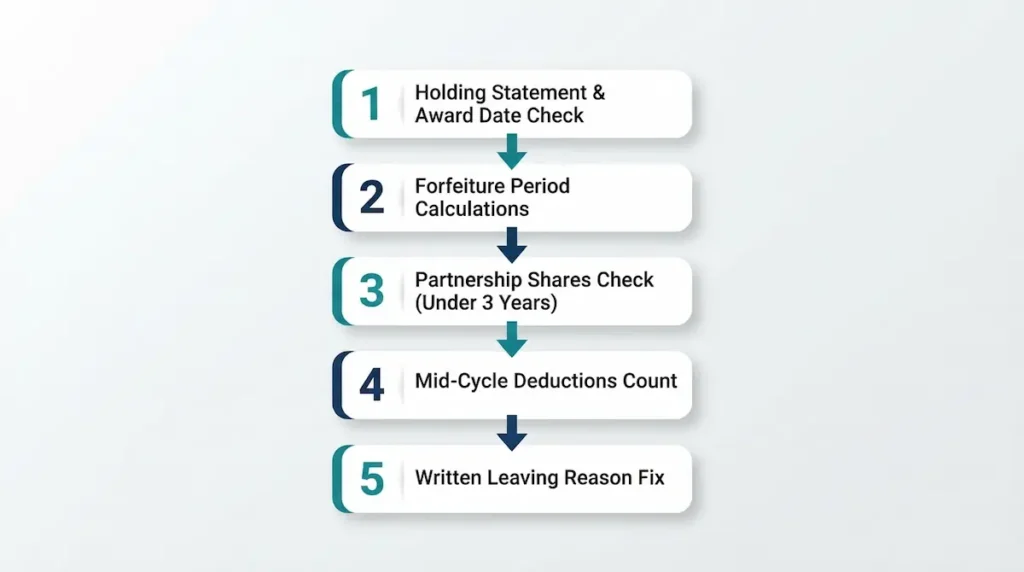
Five checks before you hand in your notice
- Get your holding statement and note the award date of each tranche. The clock runs from each award, not from the day you joined.
- Find the forfeiture period in your plan brochure. If free or matching shares fall inside it, price what you would be giving up.
- Check for partnership shares under three years old. Taking them out early pulls your matching shares with them.
- Count any mid-cycle deductions. Money not yet converted into partnership shares comes back as taxed pay, not as shares.
- Fix the leaving reason in writing if you are negotiating an exit. Redundancy and resignation produce different outcomes on the same holding.
Payroll or your plan administrator holds both documents you need. Ask for the plan brochure and your latest holding statement in one message, then run the numbers through the SIP calculator before you commit to a date.